Summary
The United Kingdom has shut down 22.5 GW of fossil fuel capacity, eliminated coal entirely (the first G7 country to do so), and reduced the carbon intensity of its electricity supply from 445 g/kWh in 2009 to 126 g/kWh in 2025. Wind now covers 30% of electricity demand. Yet the system remains structurally dependent on gas, which continues to set the wholesale price for the majority of the time even though it supplies only 30% of generation. A persistent north-south imbalance in the grid is imposing growing curtailment of wind output and has driven balancing costs steadily higher since 2020, contributing to net electricity imports of 33 TWh in 2025 (12% of the electricity mix).
Brexit created a regulatory separation from the EU's internal electricity market without removing physical interdependence. The shift from implicit to explicit interconnector capacity allocation has increased day-ahead trading costs by approximately £17 million per year (LCP Delta, 2024). Several studies suggest the broader effect on wholesale electricity prices reached £120–370 million for 2022 alone, with a possible cumulative figure of up to £500 million over the current parliamentary term (Energy UK). The Multi-Region Loose Volume Coupling mechanism envisaged by the EU-UK Trade and Cooperation Agreement (TCA) missed its 2022 deadline and remains to this day in conceptual validation. The situation is further complicated by the Windsor Framework, under which Northern Ireland remains integrated into the EU wholesale electricity market, while the rest of the United Kingdom trades with the EU on the terms reserved for third countries.
Carbon market decoupling adds further costs. Frontier Economics estimates that the UK Treasury could forgo between £3.5 billion and £8 billion in revenues as a result of carbon price misalignment, and that the EU's Carbon Border Adjustment Mechanism (CBAM) could transfer approximately £800 million from British exporters to EU member states between 2026 and 2030. AFRY projects that the CBAM could increase curtailment on the British grid by up to 50% (equivalent to 8 GW of offshore wind by 2040), with annual export revenue losses of between £900 million and £2.4 billion.
Aware of these costs, the United Kingdom is negotiating a return to the EU electricity framework. An exploratory agreement of December 2025 indicates that access to the European electricity framework would require dynamic regulatory alignment (notably on state aid and renewable energy targets), a role for the Court of Justice of the European Union on questions of EU law, and a British financial contribution. In March 2026, the Council made market access conditional on a permanent UK contribution to the EU cohesion fund — a condition London contests. The Bilaterals III package concluded with Switzerland (€375 million for the electricity sector alone, as part of a broader access deal) sets a precedent but may not translate directly into a single sectoral agreement. The failure of the UK's attempt to join SAFE, the EU defence fund, due to a dispute over the contribution amount in November 2025, illustrates the difficulty of bridging this gap.
Over the past two decades, the United Kingdom has decarbonised its electricity system faster than any other G7 country. In 2000, the mix was still dominated by fossil fuels: gas accounted for approximately 40% of output, coal around 32%, and nuclear around 22.5%[1]. By 2025, this picture had changed markedly. Low-carbon sources accounted for nearly 65% of generation, with renewables alone supplying more than half of British electricity for the first time.[2]
This shift rested on two parallel developments: the rapid exit of domestic fossil fuel generation and a major expansion of renewables, particularly offshore wind. Over the past decade, the United Kingdom closed 22.5 GW of fossil fuel capacity, including 18 GW of coal[3]. The symbolic endpoint came in 2024, when Ratcliffe-on-Soar, the country's last coal-fired power station, closed. The United Kingdom thereby became the first G7 country to eliminate coal entirely from its electricity mix.
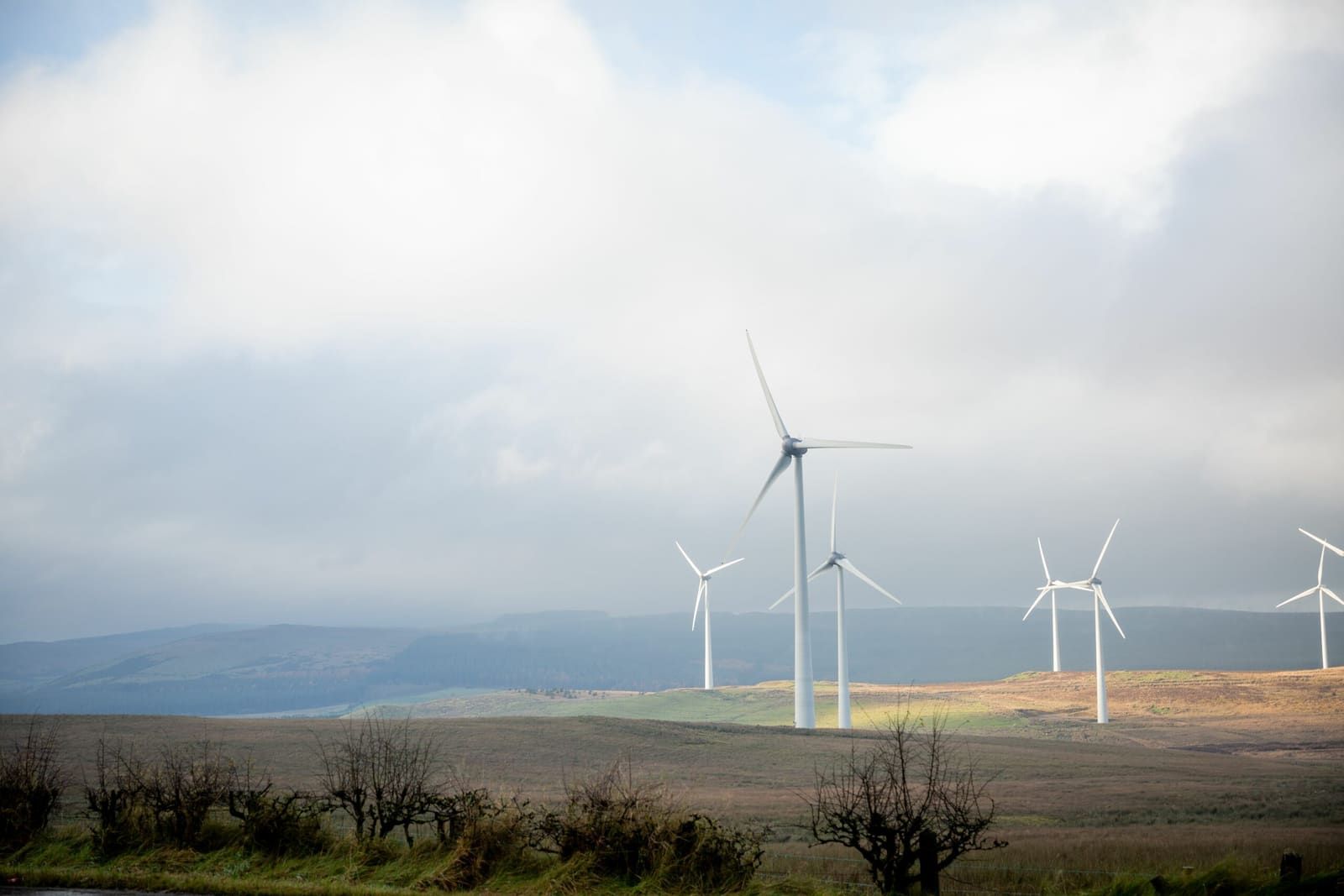
Wind is now at the heart of the British electricity mix. The UK's total wind capacity has roughly doubled since 2017, reaching ~30 GW in 2024[4]. This expansion propelled the United Kingdom to the top of European wind markets. According to WindEurope's 2024 statistics, wind covered 30% of UK electricity demand that year, behind only Denmark (56%), and broadly in line with Ireland (33%), Sweden (31%) and Germany (30%) (WindEurope 2024).
Source: Department for Energy Security and Net Zero (2025), Digest of UK Energy Statistics (DUKES): Electricity (Chapter 5), table 5.6.
As coal was phased out of the system and renewables expanded, the carbon intensity of British electricity fell sharply, from approximately 445 g/kWh in 2009 to 274 g/kWh in 2016 and then to around 126 g/kWh in 2025. This transition is one of the main reasons for the 54% decline in the UK's territorial greenhouse gas emissions between 1990 and 2025[5]. Over that period, emissions from electricity supply fell by 82%, making the evolution of the electricity mix the primary driver of the overall decline in UK emissions (DESNZ 2026). Electricity supply now accounts for only 10% of total UK greenhouse gas emissions.
Source: Department for Energy Security and Net Zero (2026), 2025 UK Greenhouse Gas Emissions: Provisional Figures — Statistical Release, Table 4a
01 | The main drivers of the transition
In 2019, the United Kingdom became the first major economy to enshrine a net zero target in law, committing to reach net zero carbon by 2050 under the Climate Change Act 2008[6]. But the policy architecture underpinning the transition was built much earlier, and in stages. Following privatisation in the 1990s, the UK introduced its first support mechanism for low-carbon electricity: the Non-Fossil Fuel Obligation, which ran from 1990 to 2002 and required electricity suppliers to contract specified volumes of non-fossil generation (Ofgem, n.d.). The mechanism was pioneering in its use of competitive auctions, but in practice much of the support benefited nuclear rather than new renewable capacity. It was followed by the Renewables Obligation, which remained in place until it closed to new applicants in 2017[7]. This contributed far more to the early deployment of renewables, particularly offshore wind, albeit at a relatively high cost.
A more decisive shift came in 2014 with the introduction of Contracts for Difference (CfDs) under the Energy Act 2013, replacing the Renewables Obligation with a more disciplined, auction-based support mechanism. CfDs give developers long-term revenue certainty by setting a "strike price" for electricity, typically over 15 years, with payments adjusting according to the difference between market prices and contracted prices[8]. This reduces investor risk while limiting consumers' exposure to high electricity prices. CfDs are now the UK's primary support mechanism for low-carbon electricity. Since 2014, they have supported approximately 39 GW of projects, with 10 GW operational in 2025. The most recent allocation round alone secured 14.7 GW of new capacity, including 8.4 GW of offshore wind.[9]
Another important driver was the Carbon Price Support (CPS), introduced in 2013 to add a British carbon price on top of the EU Emissions Trading System. It strengthened incentives to move away from fossil fuels at a time when EU carbon prices were low, but increased costs for British producers relative to their continental competitors. The CPS contributed to the rapid exit from coal, but its role diminished as coal left the system. Critics argued that it raised the cost of decarbonisation by taxing electricity emissions more heavily than those from other sectors. In April 2026, the government announced that the CPS would be abolished from 2028 on the grounds that it was no longer fit for purpose[10].
Policy support alone does not explain the British transition. Institutional design and geography also played a role. The clearest institutional advantage was the Crown Estate seabed regime: the Crown Estate owns and manages the vast majority of the seabed around England, Wales and Northern Ireland and therefore sits at the heart of offshore wind development[11]. A single national seabed authority enabled more coordinated leasing and spatial planning. As Crown Estate revenues are returned to the Treasury (£1.1 billion in 2024/25), the model also creates fiscal headroom[12].
Geography reinforced these institutional advantages, with Scotland benefiting from some of the strongest offshore wind resources in Europe. Offshore wind projects in British waters achieve high capacity factors — a key determinant of project economics and system performance — typically exceeding 30% and approaching 40% in favourable conditions. This gave the United Kingdom an exceptionally strong natural foundation for offshore wind. Scotland already accounts for approximately 16% of installed offshore wind capacity, with nearly 3 GW operational, and a large and growing development pipeline.[13]
02 | Persistent dependencies
The heavy concentration of generation capacity in the north of the British electricity market is also one of the system's most persistent structural weaknesses. The British electricity system is structurally imbalanced: generation is concentrated in the north while demand is centred in the south, and the transmission network has not been modernised quickly enough to bridge this gap. As a result, Scottish wind generators face some of the highest Transmission Network Use of System (TNUoS) charges in Europe[14]. When electricity cannot be transported southward, the system operator curtails output through the Balancing Mechanism, paying generators to reduce their production. This has led to a steady rise in constraint volumes and balancing costs since 2020, reflecting growing congestion as renewable capacity expands faster than the grid (NESO).
These dynamics help explain why the United Kingdom remains dependent on gas and electricity imports. In 2025, gas produced only around 26% of British electricity[15], but it continues to set the wholesale price for the majority of the time[16]. Transmission constraints, the concentration of generation in Scotland, and uniform marginal pricing reinforce this outcome: when low-cost wind cannot reach demand centres in the south, the system relies more heavily on gas-fired generation, and the marginal pricing mechanism passes these higher costs through to the entire market.
This dependence is compounded by the decline in domestic gas production from the North Sea. Output has fallen in recent years, increasing reliance on imports, particularly from Norway and LNG markets. Since gas is traded globally, even imports from close partners do not shield the United Kingdom from external shocks, as 2022 demonstrated when disruptions to European gas supply drove British electricity prices sharply higher. Limited gas storage capacity further increases exposure to price volatility compared with countries such as France and Germany.
The United Kingdom also remains dependent on electricity imports via interconnectors. Net imports reached approximately 33 TWh in 2025, equivalent to around 12% of the electricity mix, with France as the largest supplier. This reflects both structural price differentials and system design: UK wholesale prices are often higher than those in neighbouring markets, making imports economically attractive.
These effects are reinforced by the shift from conventional generation to more intermittent renewables. While the United Kingdom is increasingly dependent on wind, France continues to benefit from a large nuclear fleet providing stable, low-marginal-cost baseload generation. The result is a system in which network constraints and market design are mutually reinforcing: when cheap wind cannot be fully utilised, more expensive gas sets the price, contributing to persistently higher wholesale prices and sustained reliance on imports.
03 | The energy cost of Brexit: an integrated market disaggregated
As the case of interconnectors makes clear, Brexit did not produce a clean physical disaggregation of the British and EU electricity markets. On the contrary, the United Kingdom's dependence on electricity imports from continental Europe has grown rather than diminished. In practice, the British electricity market remains deeply embedded in the EU's internal electricity market, even though it now sits outside the legal and institutional framework that formerly governed that relationship.
The key change is that Brexit created a regulatory separation without removing physical and commercial interdependence. On paper, this gave the United Kingdom greater formal sovereignty over the rules governing its electricity market. In practice, however, interconnection now carries an inefficiency premium. Recognising that it is neither feasible nor desirable to resolve this by disconnecting the markets, the United Kingdom is now seeking a path back into the EU electricity framework.
1. The legal architecture of EU-UK electricity market negotiations
The Trade and Cooperation Agreement (TCA), signed on 30 December 2020, has governed EU-UK relations since the end of the transition period. It facilitates trade and investment between the two parties but does not replicate the single market. The United Kingdom therefore no longer participates in the EU's integrated regulatory frameworks, including those governing energy. Part Two, Title VIII of the TCA covers energy. It sets out high-level provisions on electricity market competition, interconnector trading, network development, security of supply, technical cooperation, the promotion of safe and sustainable energy, and trade in energy goods and raw materials.[17]
At the EU-UK Summit of May 2025, both parties reaffirmed their commitment to the TCA and agreed to extend energy cooperation, subsequently formalised by a Partnership Council decision allowing the continuation of the energy title beyond its expiry in June 2026[18]. The two parties also adopted a Common Understanding, in which they committed to exploring the conditions for possible UK participation in the EU's internal electricity market, including access to electricity trading platforms for day-ahead, intraday and other relevant timeframes.[19] This supplements but does not amend the TCA: it is a political framework for future negotiations, not a legally binding market access agreement.
One of the clearest post-Brexit inefficiencies lies in cross-border electricity trading. Once the EU and British electricity markets were separated on a regulatory basis, interconnector trading shifted from implicit to explicit capacity allocation. Under implicit allocation, interconnector capacity is assigned automatically as part of the transaction itself. Before Brexit, the EU's Single Day-Ahead Coupling system allocated capacity and matched prices simultaneously. After Brexit, no equivalent mechanism remained in place for the United Kingdom. Traders instead had to bid separately for interconnector capacity and electricity, border by border, creating greater uncertainty, lower price transparency and less efficient use of interconnector infrastructure[20].
The TCA envisaged a more efficient day-ahead trading model based on Multi-Region Loose Volume Coupling (MRLVC), and tasked British and EU transmission system operators with developing the necessary technical procedures. However, the April 2022 deadline was missed, and the framework remains under development. In 2025, MRLVC was still at a concept validation stage, with key design and implementation challenges unresolved[21]. As a result, progress has been slower than anticipated, and the model continues to face technical and operational uncertainties.
The picture is further complicated by the asymmetry between the British electricity market and the Single Electricity Market on the island of Ireland, where Ireland and Northern Ireland continue to operate as a single wholesale market with physically interconnected networks and a single cross-border trading framework. Following Brexit, the Windsor Framework established a distinct protocol for Ireland and Northern Ireland designed to preserve an open land border, in keeping with the 1998 Good Friday Agreement. The practical result is that Northern Ireland remains governed by EU wholesale electricity market rules, while the rest of the United Kingdom trades with the EU on the third-country terms set out in the TCA.
This matters both for the rest of the United Kingdom and for its negotiations on re-integration into the internal electricity market, including access to electricity trading platforms. Any future arrangement would need to be legally coherent with the regime already in place in Northern Ireland under the Windsor Framework. It is difficult to see how two overlapping but potentially inconsistent legal frameworks for electricity trading could operate durably within a single state.
2. The economic costs of decoupling
The cost of post-Brexit electricity trading inefficiencies is likely to be substantial. Estimates suggest that day-ahead trading costs per interconnector have increased by approximately £17 million per year (LCP Delta, 2024). Energy UK argues that the broader effect on wholesale electricity prices reached between £120 million and £370 million for 2022 alone, and could amount to £500 million over the current parliamentary term at current prices.
A larger cost may, however, prove to be structural rather than merely transactional. Inefficient trading also discourages investment in shared infrastructure such as Multipurpose Interconnectors (MPIs), where offshore wind farms are connected to more than one country simultaneously. Two such projects are currently planned between Great Britain and the EU. Energy UK's analysis of European Commission data suggests that MPIs could reduce the cost of achieving the broader target of 300 GW of offshore wind capacity in the North Sea by 2050 by up to £13 billion. As the North Sea becomes more central to Europe's renewable strategy, the deterrent effect on this type of infrastructure could matter more than the direct trading costs themselves.
There is also a broader economic cost from the United Kingdom's decoupling from EU climate policy frameworks, in particular the EU Emissions Trading System (ETS) and the Carbon Border Adjustment Mechanism (CBAM). Frontier Economics estimates that if UK and EU carbon prices remain misaligned over 2025–30, the UK Treasury could forgo between £3.5 billion and £8 billion in revenues compared with a scenario in which the two markets were linked[22]. The same analysis projects that the EU CBAM could transfer up to £800 million from British exporters to the EU budget by 2030 in the affected sectors. In the electricity sector, the implications could be particularly acute, notably for electricity exports and curtailment on the British grid.
A central question is how the CBAM defines the carbon intensity of electricity. If the methodology overestimates the carbon content of British exports, electricity exporters could face excessive carbon costs, undermining their competitiveness. AFRY estimates that the EU CBAM could increase curtailment on the British grid by up to 50%, equivalent to 8 GW of offshore wind by 2040. Since much of this electricity would otherwise have been exported, the resulting loss of export revenues could reach between £900 million and £2.4 billion per year at current wholesale prices. At that scale, the reduction in cross-border flows could begin to shape investment decisions, both for new projects and for the performance of existing assets.
3. A reset framework in the making
Following the Common Understanding of May 2025, the United Kingdom and the Commission agreed in December 2025 on the outcome of exploratory discussions regarding a future electricity agreement. The text is neither legally binding nor a formal negotiating mandate, but it is the clearest indication to date of what a future agreement might entail. The three most sensitive questions are dynamic alignment, the role of the Court of Justice of the European Union, and the British financial contribution.
On dynamic alignment, the text indicates that the United Kingdom should remain aligned with the relevant EU electricity rules and implement them at the same time as the EU. The aim is to preserve a level playing field in electricity trading, renewables and state aid, while allowing the United Kingdom to pursue objectives such as affordability, security of supply and grid stability within the EU framework. It also points toward alignment with EU renewable energy rules and an indicative overall renewable energy target, tying climate policy more closely to broader sovereignty debates in the United Kingdom.
The agreement would also require alignment with EU state aid rules where support affects the electricity sector or the broader energy market. Existing support schemes are likely to retain their value, but future oversight will probably require the establishment of a new independent British authority alongside the European Commission. The Competition and Markets Authority (CMA) does not currently have such a mandate, so primary legislation would be necessary. In practice, this would constrain the United Kingdom's room for manoeuvre in the design of its CfD regime and could bring it closer to EU industrial policy in electricity, particularly where the Net-Zero Industry Act shapes support conditions, technology priorities or the use of non-price criteria in auctions. This matters politically because the United Kingdom has no equivalent framework.
On the role of the Court of Justice of the European Union, the text envisages independent arbitration but with the Court remaining the ultimate authority on questions of EU law. In effect, the United Kingdom could not benefit from an electricity agreement based on dynamic alignment while reserving the right to interpret the underlying EU rules itself. This is politically and constitutionally significant, since excluding any formal role for the Court was a central British red line in the original Brexit negotiations, and the TCA does not accord it that role in its own dispute settlement system.
On the British financial contribution, the text indicates that participation in a future electricity agreement would require the United Kingdom to cover the relevant costs of the EU's work in this area[23]. This does not form part of the TCA itself, but rather the Commission's broader conditions for participation in the internal electricity market. A contribution to cover administrative or agency costs is not particularly controversial in itself; the political sensitivity lies in whether this principle could expand once formal negotiations are under way.
The December text was merely the exploratory stage. On the same day as its publication, 22 December 2025, the Commission transmitted to the Council its formal recommendation to open negotiations.[24] This broadly followed the exploratory text, but added one important element that had not been jointly agreed: a permanent and legally binding British contribution to the EU economic and social cohesion fund, proportionate to the level of internal market access granted[25]. In its explanatory memorandum to Parliament on 4 February 2026, the British government explicitly stated that this went beyond the exploratory discussions. On 30 March 2026, the Council adopted a mandate authorising the Commission to negotiate two linked but legally distinct agreements: one on UK participation in the EU's internal electricity market, and another on its cohesion contribution.[26] This hardened the EU's position by treating the cohesion payment not as a clause within the electricity agreement but as a parallel condition of market access.
The clearest precedent is Switzerland. When Berne signed the Bilaterals III in March 2026, integrating Switzerland into the EU's internal electricity market after its exclusion in 2014, it agreed to contribute €375 million to the cohesion fund[27]. But this covered a far broader package, including free movement, food safety, public procurement, research programmes and electricity. The United Kingdom, by contrast, is seeking access to electricity alone, and London's argument is that any contribution should therefore be considerably smaller. Even so, the gap may prove difficult to bridge: the UK's attempt to join SAFE, the EU defence fund, failed in November 2025 when the two parties could not agree on the size of the British financial contribution.
Bibliography
- AFRY Management Consulting. EU CBAM Impact Study Focused on Electricity: Summary Report. March 2024. https://afry.com/sites/default/files/2024-03/afry\_eu\_cbam\_impact\_study\_summary\_report\_mar\_2024\_v200.pdf.
- Cabinet Office. Explanatory Memorandum on COM(2025) 804: Recommendation for a Council Decision Authorising the Opening of Negotiations on the Participation of the United Kingdom in the Internal Electricity Market of the Union. February 4, 2026.
- Climate Change Act 2008 (c. 27) (UK). https://www.legislation.gov.uk/ukpga/2008/27/contents.
- Council of the European Union. "EU-UK Relations: Council Greenlights Talks on Electricity and Cohesion Deals, as Well as UK's Participation in Erasmus+ for 2027." Press release, March 30, 2026.
- The Crown Estate. "The Crown Estate Delivers £1.1 Billion Net Revenue Profit for the UK and Scales Up Investment for Future Value Creation." Press release, July 1, 2025.
- The Crown Estate. UK Offshore Wind Report 2024. 2025.
- Department for Energy Security and Net Zero. "New Auction Delivers Unprecedented Clean, Homegrown Power." Press release, GOV.UK, February 10, 2026.
- Department for Energy Security and Net Zero. Contracts for Difference. GOV.UK, 2025. https://www.gov.uk/government/collections/contracts-for-difference.
- Department for Energy Security and Net Zero. Digest of UK Energy Statistics (DUKES): Electricity (Chapter 5). GOV.UK, 2025.
- Department for Energy Security and Net Zero. Energy Trends: UK Electricity (Section 5), Table ET5.1. GOV.UK, March 2026.
- East Grampian Coastal Partnership. "Offshore Wind Capacity." State of the Coast. Last reviewed March 20, 2025.
- Energy UK. Energy UK Explains: The Cost of the UK–EU Relationship for Energy. October 2024.
- EU and UK Transmission System Operators. Joint Report for the Specialised Committee on Energy: Multi-Region Loose Volume Coupling (MRLVC). September 25, 2025.
- European Commission and United Kingdom. A Renewed Agenda for European Union–United Kingdom Cooperation: Common Understanding. May 19, 2025.
- European Commission and United Kingdom. Outcome of the Exploratory Discussions on the Possible Participation of the United Kingdom in the European Union's Internal Electricity Market. December 22, 2025.
- European Commission. A Renewed Agenda for European Union–United Kingdom Cooperation: Common Understanding. Statement STATEMENT/25/1267, May 19, 2025.
- European Commission. Recommendation for a Council Decision Authorising the Opening of Negotiations on the Participation of the United Kingdom in the Internal Electricity Market of the Union and on the Financial Contribution. COM(2025) 804 final (Council doc. 17112/25), December 22, 2025.
- Federal Department of Foreign Affairs. Package Switzerland–EU (Bilaterals III). Switzerland's European Policy, 2026.
- Frontier Economics. Brexit and Interconnectors: A £45m Problem? 2021.
- Frontier Economics. Linking UK and EU Carbon Markets. Report prepared for Centrica, Drax, Equinor, National Grid, SSE and Uniper, 2024.
- HM Government. The Windsor Framework. GOV.UK, 2023.
- HM Treasury. Carbon Price Support. Written Ministerial Statement, House of Commons, HCWS1519, April 16, 2026.
- House of Lords European Union Committee. Beyond Brexit: The Institutional Framework. HL Paper 246, ch. 4, 2021.
- National Energy System Operator. "Historic Generation Mix and Carbon Intensity." Dataset, NESO Data Portal. Accessed June 14, 2026.
- Ofgem. "Wholesale Energy Costs and Your Bills." Ofgem (blog). Accessed June 14, 2026.
- Partnership Council (EU–UK Trade and Cooperation Agreement). Decision No 2/2025 of 19 June 2025 Interpreting Article 331(2) and Extending the Application of Title VIII (Energy). GOV.UK.
- The Renewables Obligation Order 2002, SI 2002/914, art. 3 (UK).
- RenewableUK. "UK Wind Power Reaches Historic 30GW Milestone." August 2024.
- RenewableUK. Charging the Wrong Way: How Electricity Generators Access the GB Market. London: RenewableUK, May 2021.
Sources
- Department for Energy Security and Net Zero (2025), Digest of UK Energy Statistics (DUKES): Electricity (Chapter 5), GOV.UK, https://www.gov.uk/government/statistics/electricity-chapter-5-digest-of-united-kingdom-energy-statistics-dukes.
- Ibid.
- Ibid.
- RenewableUK, "UK Wind Power Reaches Historic 30GW Milestone," August 2024, https://www.renewableuk.com/news-and-resources/press-releases/uk-wind-power-reaches-historic-30gw-milestone/
- National Energy System Operator, "Historic Generation Mix and Carbon Intensity" (dataset), NESO Data Portal, accessed June 14, 2026, https://www.neso.energy/data-portal/historic-generation-mix
- Climate Change Act 2008 (c. 27), https://www.legislation.gov.uk/ukpga/2008/27/contents.
- The Renewables Obligation Order 2002, SI 2002/914, art. 3, https://www.legislation.gov.uk/uksi/2002/914/article/3/made.
- Department for Energy Security and Net Zero (2025), Contracts for Difference, GOV.UK, https://www.gov.uk/government/collections/contracts-for-difference.
- Department for Energy Security and Net Zero, "New Auction Delivers Unprecedented Clean, Homegrown Power," press release, GOV.UK, February 10, 2026, https://www.gov.uk/government/news/new-auction-delivers-unprecedented-clean-homegrown-power.
- HM Treasury (2026), Carbon Price Support, Written Ministerial Statement, House of Commons, HCWS1519, 16 April 2026,https://questions-statements.parliament.uk/written-statements/detail/2026-04-16/hcws1519.
- The Crown Estate (2025), UK Offshore Wind Report 2024, https://www.datocms-assets.com/136653/1747814298-osw-report-2024.pdf.
- The Crown Estate, "The Crown Estate Delivers £1.1 Billion Net Revenue Profit for the UK and Scales Up Investment for Future Value Creation," press release, July 1, 2025, https://www.thecrownestate.co.uk/news/the-crown-estate-delivers-1.1-billion-net-revenue-profit-for-the-UK.
- East Grampian Coastal Partnership, "Offshore Wind Capacity," State of the Coast, last reviewed March 20, 2025, https://www.stateofthecoast.scot/the-maritime-industry/offshore-wind-capacity/.
- RenewableUK, Charging the Wrong Way: How Electricity Generators Access the GB Market (London: RenewableUK, May 2021), https://www.renewableuk.com/media/z5rnyj45/210524_tnuos_paper_final_for.pdf.
- Department for Energy Security and Net Zero, Energy Trends: UK Electricity (Section 5), table ET5.1, GOV.UK, March 2026, https://www.gov.uk/government/statistics/electricity-section-5-energy-trends.
- Ofgem, "Wholesale Energy Costs and Your Bills," Ofgem (blog), accessed June 14, 2026, https://www.ofgem.gov.uk/blog/wholesale-energy-costs-and-your-bills.
- European Commission (2025), A Renewed Agenda for European Union–United Kingdom Cooperation: Common Understanding, Statement STATEMENT/25/1267, 19 May 2025, https://ec.europa.eu/commission/presscorner/detail/en/statement_25_1267.
- Partnership Council (EU–UK Trade and Cooperation Agreement), Decision No 2/2025 of 19 June 2025 interpreting Article 331(2) and extending the application of Title VIII (Energy), GOV.UK, https://www.gov.uk/government/publications/trade-and-cooperation-agreement-partnership-council-decision-number-2-for-2025-energy/trade-and-cooperation-agreement-partnership-council-decision-number-2-for-2025-energy-html.
- European Commission and United Kingdom (2025), A Renewed Agenda for European Union–United Kingdom Cooperation: Common Understanding, 19 May 2025, https://assets.publishing.service.gov.uk/media/682afb7002662c6f8ec243ef/UK\_EU\_Summit\_-\_Common\_Understanding.pdf.
- Frontier Economics (2021), Brexit and Interconnectors: A £45m Problem?, https://www.frontier-economics.com/uk/en/news-and-insights/articles/article-i8192-brexit-and-interconnectors-a-45m-problem/.
- HM Government (2023), The Windsor Framework, GOV.UK, https://www.gov.uk/government/publications/the-windsor-framework.
- Frontier Economics, Linking UK and EU Carbon Markets, report prepared for Centrica, Drax, Equinor, National Grid, SSE and Uniper (2024), https://www.frontier-economics.com/media/0j1h3gyw/frontier-economics-linking-uk-eu-carbon-markets-final.pdf.
- European Commission and United Kingdom (2025), Outcome of the Exploratory Discussions on the Possible Participation of the United Kingdom in the European Union's Internal Electricity Market, 22 December 2025, https://assets.publishing.service.gov.uk/media/694922851a2e540ccd8a5454/20251222_Outcome_of_exploratory_discussion_FINAL.docx.pdf.
- European Commission (2025), Recommendation for a Council Decision authorising the opening of negotiations between the European Union and the United Kingdom … on the participation of the United Kingdom in the internal electricity market of the Union and on the financial contribution …, COM(2025) 804 final (Council doc. 17112/25), 22 December 2025, https://data.consilium.europa.eu/doc/document/ST-17112-2025-INIT/en/pdf.
- Ibid.
- Cabinet Office (2026), Explanatory Memorandum on COM(2025) 804: Recommendation for a Council Decision authorising the opening of negotiations … on the participation of the United Kingdom in the internal electricity market of the Union, 4 February 2026, https://assets.publishing.service.gov.uk/media/69847b28a886d1b3227bd6ec/2026-01-12\_Draft\_EM\_on\_EU\_Commission\_document\_COM\_2025\_804\_on\_electricity\_mandate.pdf.
- Council of the European Union, "EU-UK Relations: Council Greenlights Talks on Electricity and Cohesion Deals, as Well as UK's Participation in Erasmus+ for 2027," press release, March 30, 2026, https://www.consilium.europa.eu/en/press/press-releases/2026/03/30/eu-uk-relations-council-greenlights-talks-on-electricity-and-cohesion-deals-as-well-as-uk-s-participation-in-erasmusplus-for-2027/.